
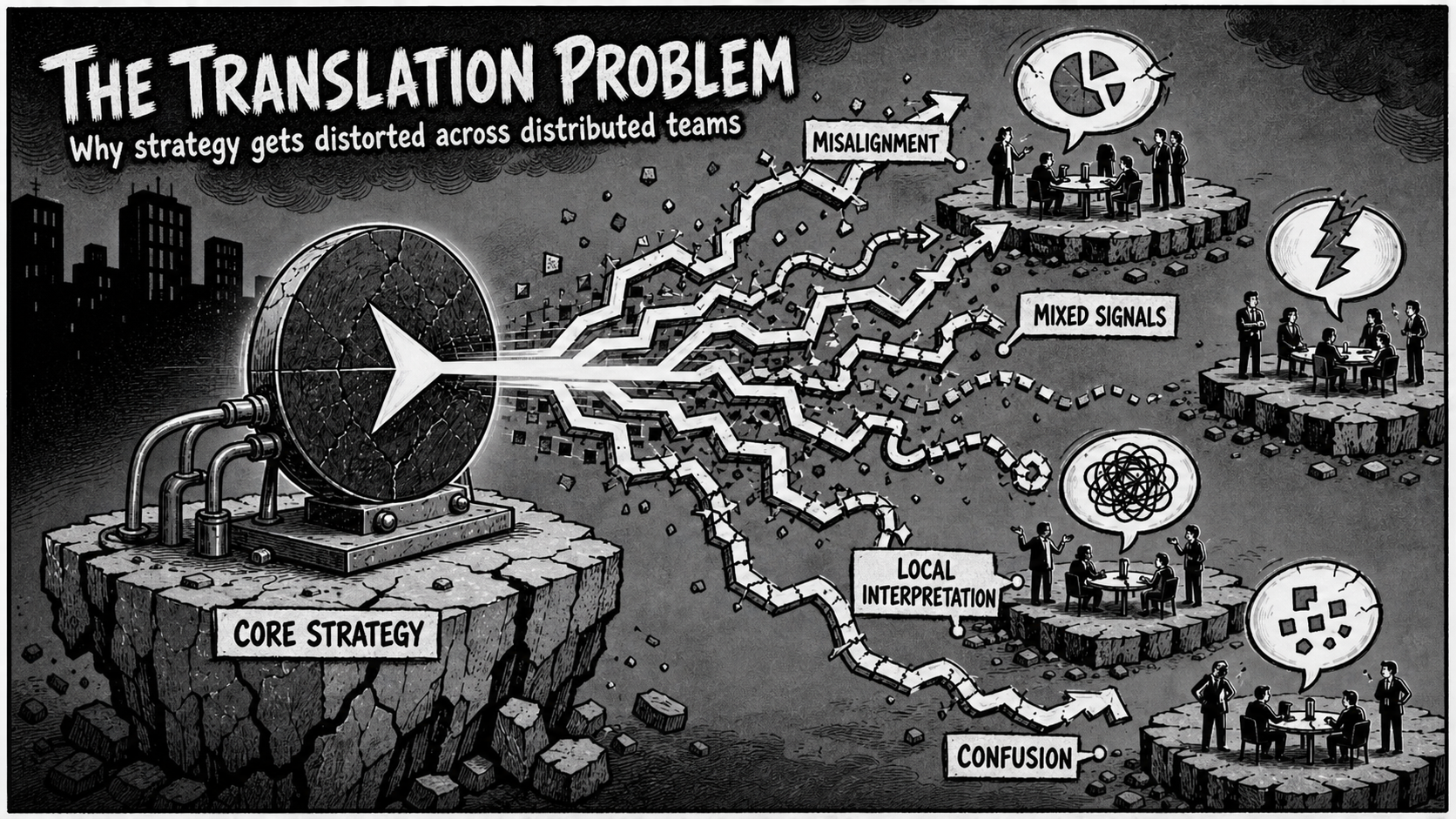
There’s a particular kind of confidence that lives in a leadership offsite.
The air is different in those rooms. Cleaner, somehow. You’re away from the operational noise: the tickets, the escalations, the time zones that never quite align. You’re surrounded by people who understand the bigger picture, speak the same strategic language, and can see roughly the same horizon you’re looking at.
By the final morning, the whiteboard is full and the energy is real. The direction feels clear. Everyone nods.
Then you get on a plane home.
And somewhere over the clouds, a quieter feeling starts to settle in. Not doubt about the strategy. That still feels solid. It’s something else: the gap between the room you’ve just left and the people who weren’t in it.
The engineer in Manila has been handling a critical escalation all week. The team lead in Dublin who covered for three colleagues whilst you were in a hotel, deciding things that will affect her team’s future. The APAC team, who will read whatever you send them at 7am between support calls, will try to work out what it means for them personally and whether it is safe to ask.
That’s the translation problem.
And most leaders don’t realise they have it until they’ve already made a mess of the first message.
What gets lost in transit
Strategic communication often fails in a very specific way. It’s not usually that the message is unclear. It’s that it answers the wrong question.
Leadership offsites produce answers to organisational questions.
- Where are we going?
- What capabilities do we need to build?
- How do we respond to the pressure we’re seeing in the market?
These are real questions. Important ones. But they are not the first questions your team is asking when you send them a summary email on a Tuesday morning.
Your team is asking something much more personal:
What does this mean for me?
Not cynically. Not selfishly. Just humanly.
People cannot fully engage with abstract organisational direction until they understand where they stand inside it. Maslow had something to say about this, but you don’t need a framework to recognise it. We all filter information through our own circumstances first. It’s not a flaw. It’s how people work.
The problem is that most leadership communication skips this step entirely.
We share the what. Sometimes we share the why. Then we assume the “so what for you” is obvious. It isn’t.
And in distributed teams, where people are physically separated from the context, energy, side conversations and informal cues that shaped the decision, the gap between what you meant and what they heard can be enormous.
The room your team was actually in
Here’s the thing that is easy to forget from the elevated vantage point of a strategy offsite: whilst you were there, your team was somewhere else.
Not nowhere, somewhere specific. Somewhere demanding.
They were handling the work. The tickets that kept arriving. The customer who escalated at 11pm. The outage nobody saw coming. The colleague who called in sick. The awkward rota gap. The customer call that needed a steady voice.
They were doing the job professionally and without complaint, whilst being entirely excluded from conversations about the future of that job.
That’s not a criticism of the offsite model. Some conversations genuinely need space away from the operational noise. But it does mean your team has a legitimate claim on being acknowledged before they can be expected to absorb anything new.
The most common failure I’ve seen in post-offsite communication is not poor messaging. It’s the absence of that acknowledgement.
The leader comes back energised and wants to share the excitement. Understandable. But the team can experience it as someone who has been away for a few days, walking back in and immediately talking about themselves.
Before asking “how do I explain this?”, there’s a better question:
What has my team been carrying whilst I was gone, and have I shown them that I see it?
The three levels of meaning
Once that acknowledgement is real — not a polite paragraph before the “proper” content starts — there’s a useful way to think about translating strategy into something that actually lands with individual contributors.
The first level is operational: what changes about how we work?
New priorities. Different processes. Resources are moving around. Things stopping. Things starting. This is what most post-offsite communication focuses on. It matters, but it is nowhere near enough.
The second level is personal: what does this open up, or close down, for the people on your team?
Does this direction create opportunities to work on more interesting problems? Does it remove the friction they’ve been complaining about for months? Does it recognise skills they’ve quietly been building? Does it create uncertainty that you need to name rather than dance around?
People will listen to operational information. But they invest in personal meaning.
The third level is purposeful: how does this connect to something that matters beyond the company’s commercial goals?
This is the hardest to articulate without sounding like you swallowed a values deck. But when you get it right, it is powerful.
Customer experience work, done well, is genuinely about helping people. If your strategy makes it possible to have better, more human interactions with the customers your team serves, say that plainly. Don’t bury it under corporate language. Don’t make it smaller than it is.
Most leaders communicate at the first level.
The best ones find their way to the third.
The danger of authenticity theatre
There’s a version of this that goes wrong in a very particular way, and I want to name it because I’ve done it myself.
It is possible to learn the vocabulary of emotionally intelligent communication — acknowledge the team, personalise the message, connect it to purpose — whilst not actually meaning any of it.
At that point, empathy becomes packaging.
You’re not really trying to see your people inside the change. You’re trying to make the change easier to swallow.
Teams are not fooled by this for long. Distributed teams, especially, often develop sharp filters for this kind of thing. They already operate with less ambient information than co-located colleagues, so they get good at reading what is said, what is not said, and what feels slightly too carefully managed.
The test I try to use is this:
Could I have this conversation the other way around?
Could I sit with my team lead in Manila and ask what she genuinely thinks this direction means for her team? Could I listen without defending? Could I let what she says change how I communicate?
If the answer is no, then I’m probably not translating strategy. I’m just making it sound warmer.
That’s not the same thing.
What AI changes about all of this
This feels especially urgent now, as AI starts to reshape what customer experience work actually looks like.
The temptation, when communicating AI strategy to support teams, is to lead with the efficiency story.
- What gets automated?
- What gets faster?
- What capacity gets freed up?
Those outcomes may be real. But they are the wrong place to start with the people who do the work.
Most people in support and customer success roles did not choose this work because they love workflow optimisation. They chose it, at least in part, because they are good at connecting with people.
They are good at the moment when a frustrated customer becomes a heard one. They understand that what appears to be a technical problem is often also an emotional one. They know that the real issue is not the ticket but the anxiety beneath it.
That is not incidental to the work.
It is the work.
So when AI strategy is communicated primarily as a productivity play, it can send an unintended but damaging message:
The valuable part of your job is the part we’re automating. What remains is the overflow.
That message is demoralising. It is also wrong.
The more interesting truth is that when routine interactions are handled by AI, the interactions that remain are the ones that needed a human in the first place.
- The complex ones.
- The emotionally charged ones.
- The high-stakes ones.
- The relationship-defining ones.
The work that remains is no less work. It is the work that was always most important, now made visible.
That is a harder job, not an easier one.
But it can also be a more meaningful one.
If you are building a support organisation in an AI-enabled world, the question is not only “how do we protect people from this change?”
A better question is:
How do we develop people to be genuinely, unmistakably human in the moments that count?
That is the story worth telling. Not as reassurance. As a challenge. And as an honest opportunity.
The message behind the message
Here’s what I keep coming back to after any significant leadership conversation: the content of what you communicate matters, but the experience of how it lands matters more.
Your team will remember whether they felt seen in the change, or whether they felt it happened to them.
They will remember whether you came back from the offsite and asked how they had been, or whether you just sent a deck.
They will remember whether the new direction felt like it had been built with them in mind, or whether they were simply the last people to hear about it.
The translation problem is not really a communication problem. It is an attention problem.
It asks you to hold two things at once: the big-picture leadership conversations are designed for, and the specific, human reality of the people who will have to live with the decisions.
That is not easy. The offsite energy is seductive. The clarity of a well-crafted strategy is genuinely exciting. Coming back to the operational reality — the time zones, the tickets, the anxious questions hiding behind polite ones — takes a deliberate act of reorientation.
But that is the actual work. Not the strategy. Not the slides.
The moment you choose to see your team before you ask them to see the vision, the translation begins.